Before a punch had been thrown, the verdict had already been delivered.
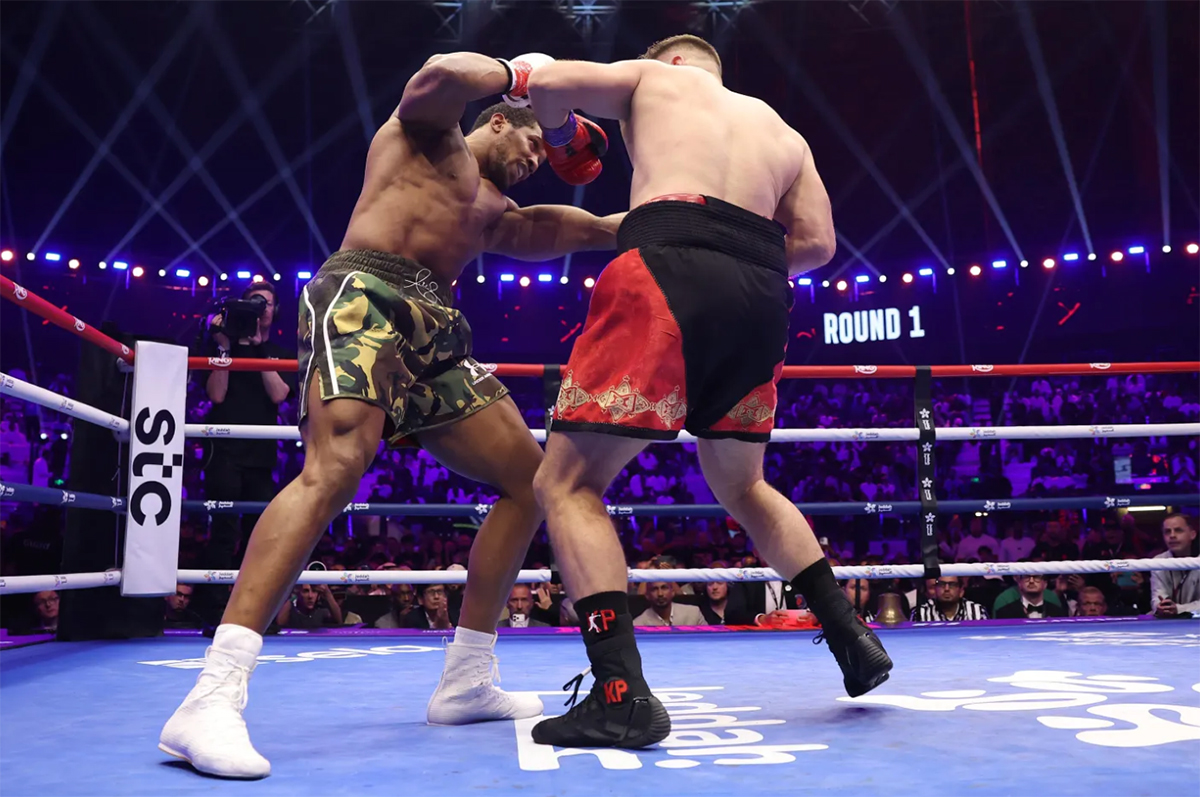
AJ looked like the gladiator. His physique was sculpted, lean and powerful. Every line of his body suggested strength, discipline and athletic excellence. Kristian Prenga looked different. Less defined. Less imposing. More like the heavyweights of an earlier generation—solid, but unremarkable and about to get his arse whooped.
Most of my pals said there was no point watching. Hearn wasn’t going to risk AJ’s massive payday against Tyson Fury. So, in their minds, the outcome had already been decided. AJ would knock Prenga out.
Then the bell rang.
Prenga’s right hand repeatedly found AJ. Twice AJ was knocked to the canvas. In less than three minutes, the gladiator appearance had become irrelevant. The fight had exposed something far more important than aesthetics: capability. Whatever conclusions had been drawn from appearance alone had dissolved within a single round.
The second round belonged to capability.
AJ survived. He regrouped. He recovered. The same man who had looked vulnerable only moments earlier became decisive, composed and clinical. He stopped Prenga. Whatever assumptions had been made before the opening bell were now meaningless. The contest had revealed what a photograph never could.
Afterwards, one commentator suggested that Prenga had shown his inexperience. Rather than continuing to exploit the right hand that had caused so much damage in the opening round, he allowed AJ time to recover. Whether that assessment is right or wrong almost misses the point.
Boxing is beautifully unpredictable. No physique can predict courage. No physique can predict judgement. No physique can predict timing. No physique can predict resilience.
One of the reasons I have always loved boxing is because it constantly challenges our assumptions. I have learned never to assume that the fighter with the superior physique is automatically the superior boxer. Aesthetics can tell us something. They never tell us everything. Movement, structure, timing, experience, adaptation and composure—these qualities reveal themselves only when the contest begins.
The same assumption follows us outside the boxing ring. We judge health by appearance. We judge ageing by appearance. We judge capability by appearance. Sometimes we are right. Often we are not.
My platform, Meta-Age, asks us to suspend that first judgement and look deeper. When we see someone who is slim and toned, we assume they are healthier than someone who isn’t. Sometimes they are. Sometimes they aren’t. When we see someone with wrinkles, we assume decline. When we see someone without wrinkles, we assume vitality. Again, sometimes that’s true. Often it isn’t.
Let me be clear about what I am not saying. I am not anti-aesthetics. I am not suggesting that physical fitness has no value, or that how we present ourselves is irrelevant. What I am saying is this: don’t mistake appearance for capability. They are different currencies, and they do not always exchange at the rate we expect.
The AJ–Prenga fight is a reminder that the body is something to observe in action, not just admire in a photograph. I can tell a great deal about someone by the way they move. That is a very different lens from judging them by how they look standing still.
Consider what movement reveals. How does someone get up from a low chair? That single action—simple, everyday and unremarkable—tells you more about functional strength than any gym selfie ever could. How do they recover their balance after a slight stumble? That tells you about coordination and the automatic systems that keep us safe. How do they breathe after climbing a flight of stairs? That tells you more about functional fitness than another photograph on social media.
Everyone’s an expert at admiring the surface and clueless when it comes to recognising function. We celebrate the six-pack while ignoring the stiff hip that aches when sitting cross-legged. We admire big biceps while overlooking the shoulder that can’t comfortably reach behind the back. We compliment the flat stomach while missing the breathlessness after climbing a flight of stairs.
Looking is easy.
Watching takes practice.
Why This Matters for Health
This isn’t rocket science. It has real consequences for how we approach our own health and how we perceive the health of others.
If you believe appearance equals capability, you’re barking up the wrong tree. You’ll chase image rather than substance. You’ll measure your progress in the mirror rather than by how well your body actually moves.
And if we believe that visible ageing equals inevitable decline, we’ll write people off too early—including ourselves. We’ll assume that wrinkles mean weakness, grey hair means limitation and slowing down means stopping. We’ll miss the resilience, the adaptation and the second-round recovery that so many people are capable of.
AJ got knocked down twice. He still won. He didn’t win because he looked like a champion. He won because he adapted, recovered and finished like one.
The Practice
So what does observing someone in action actually look like in daily life?
It starts with noticing.
When you meet someone new, resist the urge to judge their appearance. Instead, watch how they move. How do they stand? How do they shift their weight? How do they reach for something? How do they turn their head?
These observations are not judgements. They are questions. And questions are the beginning of understanding.
The same applies to yourself. Stop measuring your health by how you look in a photograph. Start measuring it by how well you can move, recover, adapt and persist. Ask yourself: can I do what I need to do? Can I do what I want to do? If the answer is yes, your body is working. If the answer is no, appearance won’t fix it—but movement, training and attention just might.
The Final Round
Boxing teaches us that the contest is never decided at the weigh-in. The real fight happens when the bell rings. The same is true of health and ageing. The real measure is not how we look when we are standing still. It is how we move when life asks us to act.
Meta-Age asks a different question. Not how impressive does someone look, but how well can they continue to participate in life?
The contest is never decided at the weigh-in. Neither is life. Capability is revealed through participation.
You do not discover what a body can do by looking at it. You discover it by watching it participate.